
When it comes to achieving a durable and high-performance resin floor, success begins long before the coating is applied. Correct surface preparation is the foundation that determines adhesion, appearance and long-term reliability.
At Monarch Resin Floors, every installation begins with proper industrial floor preparation, carried out in accordance with FeRFA guidance and British Standards. From diamond grinding to shot blasting, our methods are chosen to meet the specific requirements of each site and substrate condition.

Written by: Monarch Resin Floors
Last Updated: 28 October 2025
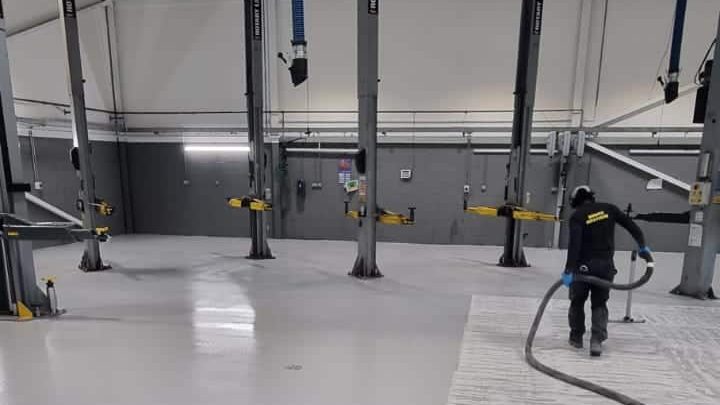


Surface preparation is the essential first step in creating a strong and reliable bond between the concrete substrate and the resin system applied above it. Before any primer or coating can perform effectively, the base surface must be sound, clean and correctly profiled.
According to FeRFA guidance, surface preparation involves removing laitance, weak material, oil, grease, or existing coatings to expose the solid concrete beneath. This process creates a mechanical key that allows the resin to anchor securely. If contaminants or weak layers remain, they can act as a barrier between the concrete and resin, leading to loss of adhesion or delamination once the system cures.
A well-prepared surface is also essential for consistent curing and chemical bonding. Resin systems rely on intimate contact with the substrate; any remaining dust, moisture or unevenness disrupts that bond. Proper preparation ensures that primers and coatings penetrate into the pores of the concrete rather than simply sitting on the surface, which increases adhesion strength and overall performance.
FeRFA notes that surface preparation should be considered a technical operation requiring training, correct equipment, and environmental control. The result should be a uniform, open-textured surface free from contaminants and surface irregularities, suitable for the type of resin flooring being applied.
The long-term performance of a resin floor depends as much on the condition of the substrate as on the materials used to coat it. Even a high-quality epoxy or polyurethane system can fail prematurely if the concrete below has not been properly prepared. Poor preparation is one of the most common causes of issues such as bubbling, debonding, and osmotic blistering.
By mechanically preparing the surface, installers achieve a stable bond line that transfers stresses evenly between the substrate and resin. This ensures the coating behaves as a single, integrated system rather than two separate layers. It also allows primers to wet the surface fully, sealing capillaries and reducing air release, which prevents pinholes in the final finish.
Surface preparation also plays a vital role in moisture control. Concrete naturally contains water, and if that moisture is not measured and managed, vapour can rise through the slab and disrupt the bond. FeRFA recommends testing all substrates to determine relative humidity before installation. When moisture levels are too high, a damp proof membrane system must be used to protect the resin coating.
Beyond adhesion and moisture resistance, correct preparation improves surface uniformity, slip resistance, and chemical durability. By starting with a clean, properly profiled surface, installers ensure that the resin system achieves its designed performance characteristics—whether that means resisting heavy traffic in a warehouse, frequent cleaning in a food factory, or mechanical impact in an engineering workshop.
Ultimately, good preparation is not just about visual finish; it is about long-term reliability. It ensures that the investment made in an industrial resin floor delivers full performance throughout its service life.
Once the substrate has been inspected, tested, and cleaned, the next stage is selecting the correct surface preparation method. The choice depends on the condition and strength of the concrete, the resin system being installed, and the required surface profile.
According to FeRFA’s Guide to Preparing Surfaces for the Application of Resin Systems, preparation includes all processes necessary to produce a surface that is clean, sound, and capable of receiving a resin floor. While this primarily involves mechanical methods such as grinding, shot blasting, or planing, it also extends to associated steps including substrate repairs and priming. Together, these ensure that the concrete is stable, sealed, and ready to achieve full bond strength with the subsequent resin system.
Each preparation stage serves a specific purpose — from removing weak surface layers to improving adhesion and managing residual moisture. FeRFA and BS8203 both emphasise that mechanical preparation should always be followed by thorough cleaning and vacuum extraction to remove dust and contamination before priming. Any surface repairs, such as filling blowholes or cracks, must be carried out using resin-based mortars compatible with the intended flooring system.
At Monarch Resin Floors, our teams follow these procedures precisely. We combine mechanical profiling, localised repair, and correct primer selection to create a substrate that is uniform, durable, and ready to support high-performance resin flooring systems.
The table below summarises the principal FeRFA-recognised methods used in industrial resin flooring projects, along with their purpose and key guidance for best practice.
| Method | Description | Typical Use | FeRFA Guidance |
|---|---|---|---|
| Diamond Grinding | Uses rotating diamond segments to remove laitance, sealers and light coatings. Produces a smooth, even surface with a fine profile. | Ideal for coating systems up to FeRFA Type 3 or as a finishing step after shot blasting. | Remove all dust after grinding and ensure a consistent finish. |
| Shot Blasting | Propels small steel shot at high velocity to clean and texture the concrete, creating a controlled mechanical key. | Most common for industrial floors receiving resin coatings or screeds. | Not suitable for damp substrates; remove all shot residue before coating. |
| Planing or Scabbling | Uses flails or cutters to remove high spots or thick coatings, producing a coarse surface texture. | Used for heavy-duty applications or when removing existing screeds. | Follow with grinding to refine the surface and ensure uniformity. |
| Multi-stripping / Scraping | Mechanically removes old floor coverings, adhesives or membranes. | Ideal for refurbishment or dilapidation works prior to further preparation. | Always follow with mechanical grinding or blasting before resin application. |
| Surface Repairs | Fills voids, cracks, or damaged concrete using compatible resin mortars or epoxy repair compounds. | Used after mechanical preparation to stabilise the substrate and restore flatness. | FeRFA advises using repair materials compatible with the final system and allowing full cure before coating. |
| Priming | Applies a resin-based primer to seal and bind the surface, improving adhesion between the concrete and the main flooring system. | Final stage before coating or screed installation. | Primers should be selected according to substrate condition and manufacturer guidance, as outlined in FeRFA and BS8203. |
| Vacuum Cleaning | Removes dust and debris following all mechanical preparation and repair work. | Essential on every project before priming or coating. | Ensures surfaces are free from contamination between layers. |
At Monarch Resin Floors, our technicians select the appropriate combination of these methods based on substrate condition, moisture readings, and the system being installed.
Choosing the right method depends on several practical and technical factors:
Condition and strength of the concrete substrate
Presence of coatings, laitance or contaminants
Moisture content (measured in accordance with BS 8203)
Type and thickness of resin system specified
Working environment and temperature
For example, diamond grinding provides a smooth, fine finish ideal for thin-film epoxy coatings, while shot blasting creates a stronger mechanical key suited to thicker polyurethane screeds.
In refurbishment environments, existing layers may be removed using planers or multi-stripping equipment, followed by fine grinding to achieve a uniform texture.
You can learn more about these techniques on our Shot Blasting and Diamond Grinding page.
Moisture and contamination are two of the most critical factors influencing the success of a resin flooring installation. Even if the mechanical preparation is perfect, a coating or screed can still fail if moisture levels are too high or contaminants remain within the concrete surface.
According to FeRFA and BS 8203, all substrates should be tested before installation to determine relative humidity (RH) and the presence of oil, grease, or chemical residues. For concrete, an RH reading below 75% is generally considered safe for coating or screed application. If readings exceed this level, the substrate requires a surface-applied Damp Proof Membrane (DPM) system to prevent moisture vapour transmission.
Contamination can also interfere with adhesion. Oils, fuels, laitance, curing agents, and other surface residues can form a barrier between the resin and the concrete. Mechanical removal through shot blasting or grinding is the most effective method, but in some cases, an oil-tolerant primer may be necessary to bind residual contamination within the surface.
At Monarch Resin Floors, moisture testing and contamination checks form part of our standard preparation process. We use calibrated digital hygrometers and surface inspection to determine whether the substrate requires a DPM, oil-tolerant primer, or further mechanical cleaning before priming.
| Issue | Cause | Recommended Action | FeRFA / Manufacturer Guidance |
|---|---|---|---|
| High Moisture Content | Residual moisture within concrete exceeding 75% RH. | Apply a surface-applied Damp Proof Membrane (e.g. Resdev Pumaprime DPM, Monarprime DPM or Remmers Epoxy MT 100). Ensure readings are taken in accordance with BS 8203. | FeRFA: Guide to Installing Resin Flooring Systems onto Substrates with a High Moisture Content. |
| Oil or Grease Contamination | Hydrocarbon residues from machinery, production, or previous use. | Mechanically prepare using shot blasting or grinding. Apply an oil-tolerant primer (e.g. Resdev Pumaprime OCS or Sherwin-Williams Resuprime OT) if necessary. | FeRFA: Guide to Surface Preparation; Manufacturer technical data sheets. |
| Laitance or Weak Surface Layer | Thin, dusty layer of weak cement paste at the concrete surface. | Remove by diamond grinding or light shot blasting to expose sound concrete. | FeRFA: Guide to Surface Preparation; BS 8204-6. |
| Cracks or Voids | Movement or shrinkage during concrete curing or previous damage. | Fill using compatible epoxy repair mortar or resin filler before priming. | FeRFA: Codes of Practice; Manufacturer repair guidelines. |
| Surface Dust or Debris | Loose particles left after mechanical preparation. | Vacuum thoroughly with industrial extraction equipment prior to primer application. | FeRFA: All prepared surfaces must be clean, dry, and dust-free before coating. |
Always verify substrate moisture using a digital hygrometer before installation.
Follow FeRFA and BS 8203 guidance for acceptable humidity thresholds.
Choose primers or DPM systems that are manufacturer-approved for the measured conditions.
Ensure all contamination, dust, and laitance are removed or sealed before applying the resin system.
By addressing these factors during the preparation phase, installers eliminate the most common causes of resin flooring failure. Correct moisture and contamination control ensures that the resin bonds permanently to the substrate, delivering a finish that performs consistently for years.
Even with thorough surface preparation, issues can arise during or after installation that affect the performance of a resin floor. The table below outlines common surface conditions, their possible contributing factors, and typical corrective actions based on FeRFA and manufacturer guidance.
These examples are suggestive only. Determining the true cause of any failure or defect requires a detailed site inspection, moisture testing, and an understanding of environmental and operational conditions. Each site must be assessed individually before remedial work is specified.
| Issue | Possible Causes | Typical Corrective Actions | FeRFA / Manufacturer Guidance |
|---|---|---|---|
| High Moisture Readings | May result from inadequate curing, missing or damaged DPM, ground moisture ingress, or high ambient humidity at the time of testing. | Confirm moisture using a calibrated hygrometer in accordance with BS 8203. If above 75% RH, apply a surface-applied Damp Proof Membrane such as Resdev Pumaprime DPM or Remmers Epoxy MT 100 before priming. | FeRFA: Guide to Installing Resin Flooring Systems onto Substrates with a High Moisture Content. |
| Oil or Grease Contamination | Residual oils or hydrocarbons from machinery, production processes, spillages, or previous floor coverings. | Mechanically clean via shot blasting or grinding. If staining persists, apply an oil-tolerant primer such as Resdev Pumaprime OCS or Sherwin-Williams Resuprime OT before applying the resin system. | FeRFA: Guide to Surface Preparation; Manufacturer technical data sheets. |
| Laitance or Weak Surface Layer | Excessive water in concrete mix, over-trowelling, carbonation, or poor curing conditions. | Remove mechanically by diamond grinding or light shot blasting to expose sound concrete. Test pull-off strength to confirm suitability for coating. | FeRFA: Guide to Surface Preparation; BS 8204-6. |
| Cracks or Surface Voids | Possible factors include substrate movement, shrinkage, thermal stress, vibration, or impact damage. | Stabilise and fill using compatible epoxy or polyurethane repair mortars. Assess crack movement before repair to ensure long-term stability. | FeRFA: Codes of Practice; Manufacturer repair guidelines. |
| Surface Dust or Debris | Incomplete vacuum extraction after preparation, airborne dust, or contamination from nearby works. | Vacuum thoroughly using HEPA-filtered industrial extraction prior to primer application. Inspect for visible dust or residue before coating. | FeRFA: All prepared surfaces must be clean, dry, and dust-free before coating. |
| Adhesion Loss or Blistering (Post-Installation) | May occur due to trapped moisture vapour, incompatible primer, inadequate preparation, impact damage, or incorrect cleaning and maintenance. | Conduct site inspection to identify the source. Remove affected areas, re-prepare, and reapply the resin system in accordance with FeRFA and manufacturer procedures. | FeRFA: Guide to Osmosis in Resin Flooring; Manufacturer technical bulletins. |
| The information above is provided as general guidance only. Actual causes and corrective measures should always be confirmed through professional inspection and testing before any work is undertaken. | |||
At Monarch Resin Floors, we believe that a successful resin flooring system begins long before the coating is applied. Every project we undertake follows the same principle of preparation, precision, and performance.
Our trained installation teams are experienced in all recognised FeRFA surface preparation techniques, including grinding, shot blasting, and scabbling. We also carry out detailed moisture testing and substrate assessment before any work begins. This ensures that each surface is treated, repaired, and primed using the correct method for its condition.
We work with trusted manufacturers such as Resdev, Remmers, and Sherwin-Williams to specify primers, DPM systems, and coating materials that are technically suited to the site environment. Whether the floor is a new concrete slab or a refurbishment of an existing facility, our process ensures full compliance with FeRFA and BS 8203 standards.
Typical environments we prepare and install include:
Warehouses and logistics centres where durability and ease of cleaning are essential.
Food and drink facilities requiring hygienic, seamless finishes.
Manufacturing and automotive plants exposed to oils, fuels, and mechanical wear.
Commercial and retail spaces needing decorative yet robust resin systems.
Every installation is carefully planned, from initial survey through to system selection and final quality checks. We provide clear documentation, photographic records, and post-installation care guidance to ensure your resin floor continues to perform as intended.
To learn more about our preparation and installation services, visit our pages on Industrial Floor Preparation, Warehouse Flooring, and Food Factory Flooring, or browse our Case Studies to see examples of completed projects
Surface preparation is not a background task; it is the most critical stage of any resin flooring project.
By ensuring the substrate is clean, sound and correctly profiled, the installer sets the foundation for long-term performance, hygiene and safety.
At Monarch Resin Floors, we approach every floor with precision and professionalism, combining FeRFA-approved methods, manufacturer data, and decades of experience to deliver results that stand the test of time.
Whether your project involves a new installation, a refurbishment or a repair, our team can advise on the correct surface preparation method and resin system for your environment.
To arrange a site survey or discuss your next project, call us on 01246 412 222 or visit our Contact Page.
Selecting the right primer depends on several key factors:
Primers might not be visible once the floor is complete, but they can play one of the most important roles in achieving a high performance and long lasting resin floor. The right primer transforms a prepared concrete slab into a sealed and stable surface ready to bond perfectly with your chosen resin system.
At Monarch Resin Floors, every installation begins with precision preparation and the correct primer for the job. Our team brings decades of experience in designing and installing resin flooring systems across industrial, commercial, and specialist environments throughout the UK. We take pride in understanding each project’s unique requirements, from warehouse flooring and production floors to laboratories, food facilities, and automotive workshops.
Our expertise covers the full range of resin technologies including epoxy, polyurethane, and fast curing polyaspartic systems, along with screeds, coatings, and decorative finishes. Every project is carried out by trained technicians working to FeRFA standards, ensuring your floor is safe, durable, and built to perform under pressure.
Whether you need a new installation, a refurbishment, or a repair, we provide honest advice, detailed preparation, and reliable workmanship from start to finish. With a proven record of successful projects nationwide, Monarch Resin Floors is trusted by manufacturers, logistics companies, and facility managers who value quality, efficiency, and long term results.
To learn more about our systems and see examples of our work, visit our case studies or explore our industrial flooring services to discover how the right preparation and primer can transform your floor.
Call us on 01246 412 222 or request a free site survey to discuss your next flooring project. You can also fill in the contact form at the bottom of this page, or head to our contact page for more ways to get in touch.
All surface preparation should be carried out in accordance with FeRFA Guidance Notes and BS 8203. Substrate moisture levels must be tested before installation; floors exceeding 75 % RH require a damp proof membrane system.
The information provided here is intended for general guidance only. Monarch Resin Floors accepts no responsibility for variations in site conditions, changes to manufacturer specifications or errors in interpretation. Always refer to current FeRFA documents and manufacturer data sheets before specification or installation.
Pumaprime DPM – Two-part epoxy damp proof membrane suitable for concrete substrates up to 98 % relative humidity as measured in accordance with BS 8203. Provides a vapour barrier where rising damp or residual moisture is present.
Pumaprime OCS – Solvent free, low odour, epoxy resin primer/membrane for oil contaminated substrates. Designed to improve the adhesion of coatings and screed systems to substrates that have previously been contaminated with oils and have been thoroughly cleaned but may still retain some residual contamination
Remmers Epoxy MT 100 – Moisture-tolerant epoxy primer designed for substrates with up to 100% RH. Functions as a barrier coat against residual moisture and can be used beneath Remmers epoxy or polyurethane systems.
Resuprime OT – Oil tolerant epoxy primer for contaminated concrete substrates. Suitable for use in industrial environments, garages, and engineering workshops.
We would love to speak with you about your resin flooring project.
Feel free to reach out using the below details or fill out the contact form and a member of our team will get in touch with you within 48 hours.
We never pass on any of your information to third parties and will only get in touch about the flooring project your enquiring about.
We never pass on any of your information to third parties and will only get in touch about the flooring project your enquiring about.