
When it comes to achieving a long lasting and professional resin floor, success starts below the surface. Floor primers for resin flooring play a crucial role in creating a strong bond between the concrete substrate and the chosen resin flooring system. At Monarch Resin Floors, we understand that proper priming forms the foundation of a durable installation, helping to seal the surface, manage substrate porosity and support reliable adhesion.
Written by: Monarch Resin Floors
Last Updated: April 2026

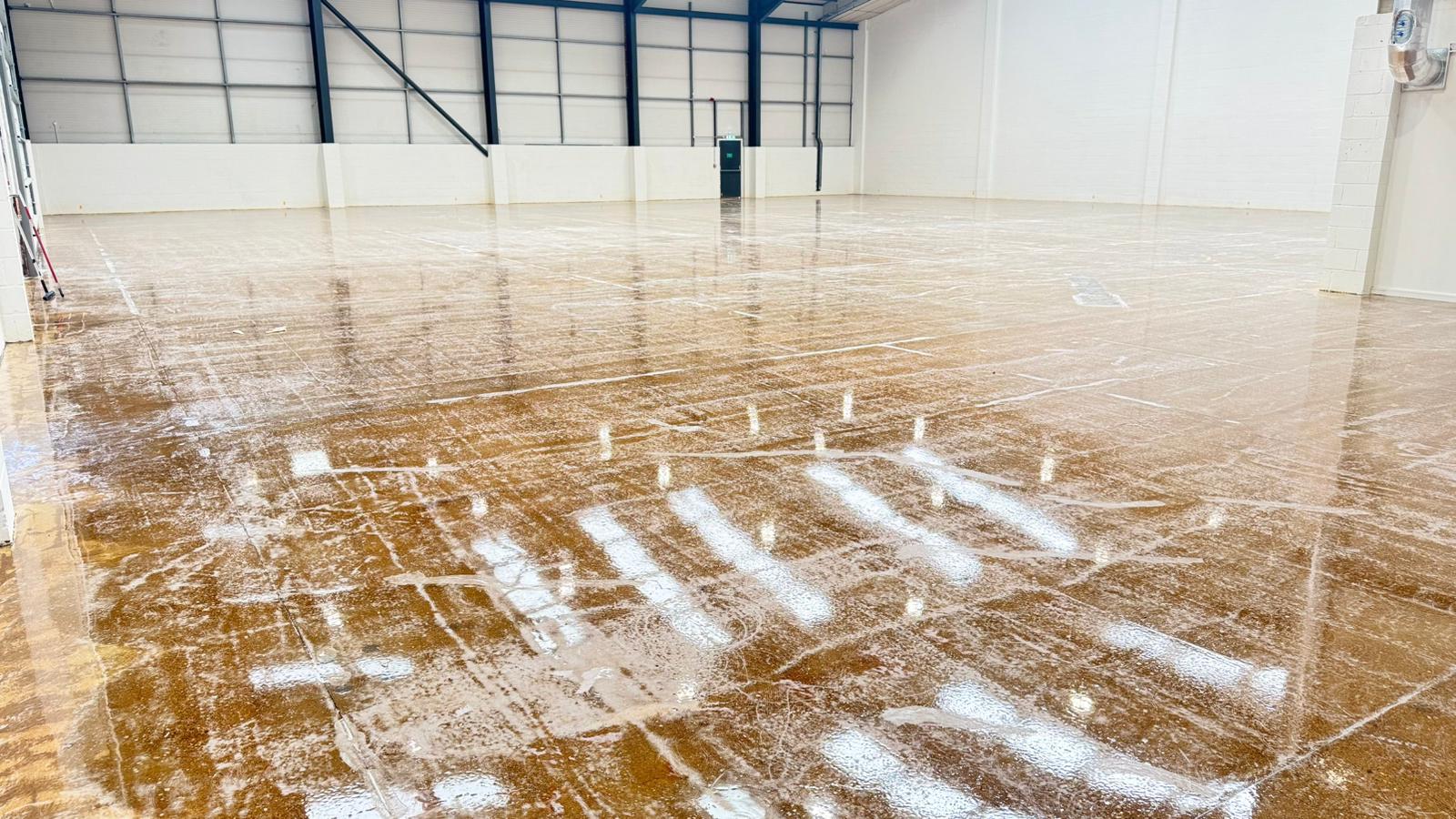

When installing an industrial resin floor, surface preparation is critical. Mechanical processes such as grinding and shot blasting create the necessary surface profile, but they do not complete the system.
The role of the floor primer is to bridge the gap between the prepared substrate and the resin flooring system. By penetrating the surface and binding remaining dust, it creates a consistent, sealed base that allows subsequent layers to perform as intended.
Without correct priming, even a well specified resin floor system may be at risk of issues such as poor adhesion, air release, or uneven curing, all of which can affect long term performance.
A floor primer is a resin based coating applied to the prepared concrete surface before the main resin or epoxy system is installed. Its purpose is to seal the substrate, improve adhesion and create a stable base for the flooring system to bond to.
By penetrating into the pores of the concrete, primers lock the resin in place and help to stop air or moisture rising through the slab which can cause pinholes or weak spots in the final finish. In some cases concrete substrates might require two primers to achieve full performance. Always get technical advice before installation.
Skipping or incorrectly applying a primer can lead to major problems later down the line. A good primer will:
Surface Preparation – The floor must first be mechanically prepared through grinding or shot blasting to remove laitance and contaminants.
Cleaning – Any dust, oil or residue must be vacuumed or cleaned away.
Mixing – The primer is mixed in exact ratios according to manufacturer guidance.
Application – Rolled or brushed evenly across the surface ensuring full coverage.
Curing – The primer is left to cure fully before applying subsequent resin layers.
At Monarch Resin Floors we follow manufacturer specifications and FeRFA guidelines for every primer and coating system to ensure consistent and high quality results.
Epoxy primers are the most widely used primer type for resin flooring installations. They provide excellent adhesion to clean, dry concrete substrates and are compatible with most epoxy and polyurethane coating systems.
According to FeRFA, epoxy primers are typically applied at 150–250 microns in a single coat and act as both a seal coat and bonding layer. When correctly applied over properly prepared concrete (in accordance with FeRFA Guide to Surface Preparation), epoxy primers help minimise pinholing and helps to ensure full chemical cross-linking between layers.
They are suitable for environments with low to moderate moisture (below 75% relative humidity) and should always be used over a sound, laitance-free surface. End users should always take moisture readings to evaluate which is the most suitable primers to use. Seek technical advice.
Polyurethane primers are chosen for their flexibility and tolerance to temperature variation. They are often specified beneath polyurethane or flexible resin flooring systems where minor substrate movement or thermal cycling may occur.
Manufacturers such as Resdev and Sherwin-Williams specify PU primers for areas subject to vibration or where the substrate may expand or contract, such as mezzanine decks, loading bays, and cold storage areas.
PU primers cure quickly, even at lower temperatures, and provide a slightly more elastic bond line than epoxy systems. However, they require a clean and dry substrate to perform effectively and are not generally moisture tolerant unless specifically formulated as such.
Moisture-tolerant primers are formulated to bond to slightly damp concrete surfaces where residual moisture levels are within acceptable limits (typically below 75% RH).
As defined in the FeRFA Guide to Installing Resin Flooring Systems on Substrates with a High Moisture Content, these primers are not moisture barriers but are designed to tolerate minor dampness without loss of adhesion.
They are ideal for refurbishment projects or floors that cannot be completely dried prior to installation. Examples include Resdev Pumaprime DPM LT / MT (used as a moisture-tolerant primer when applied in a single coat) and Remmers (MT 100).
A DPM primer, sometimes referred to as a surface-applied damp proof membrane, is a two-coat epoxy system that acts as a vapour barrier. It is essential where high moisture readings are recorded or where there is no effective DPM layer beneath the slab.
FeRFA defines DPM systems as “coatings of controlled permeability” capable of resisting moisture levels up to 97–100% RH. They help to prevent osmotic blistering, carbonation, and bond failure by stopping moisture vapour transmission through the substrate.
Manufacturers such as Resdev (Pumaprime DPM) produce epoxy DPM systems certified for use on substrates with high residual moisture. These primers are especially recommended for new or ground-bearing concrete, basements, and food or warehouse facilities subject to frequent cleaning and wash-down.
Oil-tolerant primers are designed for contaminated or previously used industrial floors where hydrocarbons such as oil, grease, or fuel have penetrated the substrate. Standard primers may not adhere correctly in these conditions, leading to delamination or blistering.
Oil-tolerant formulations chemically bind to residual contamination and create a stable surface for resin application. FeRFA guidance and manufacturer data from Resdev (Pumaprime OCS – formally Pumaprime OT) and Sherwin-Williams support their use where mechanical preparation has removed surface residue but staining remains within the substrate.
At Monarch Resin Floors we used an oil-tolerant primer during a Chesterfield factory refurbishment, allowing the contaminated concrete to be sealed and overlaid with a heavy-duty resin system. You can read the full details in our Chesterfield Case Study.
Penetrating primers, also referred to as pore fillers, are low-viscosity formulations designed to reinforce weak, dusty, or porous concrete surfaces. They penetrate deeply into the capillaries of the substrate and bind fine particles to form a cohesive surface suitable for coating.
These systems are often used as a preparatory treatment before higher-build coatings in older warehouses and plant rooms. According to the FeRFA Guide to Surface Preparation, their role is to strengthen friable concrete and reduce absorbency prior to further coating.
All primer selection should be based on moisture readings taken in accordance with BS 8203 and FeRFA testing procedures. For slabs exceeding 75% RH, a DPM system is required. Below this threshold, a moisture-tolerant primer may be sufficient. Each system should be installed following the manufacturer’s technical data sheet and FeRFA installation guidance by professional resin flooring contractors.
Selecting the right primer depends on several key factors:
Before priming, floors are mechanically prepared to remove contaminants and create a clean surface.
Learn more about our Industrial Floor Preparation process. Once primed, we apply high performance resin systems designed for each environment, from Warehouse Flooring to Food Factory Flooring.
Primers might not be visible once the floor is complete, but they can play one of the most important roles in achieving a high performance and long lasting resin floor. The right primer transforms a prepared concrete slab into a sealed and stable surface ready to bond perfectly with your chosen resin system.
At Monarch Resin Floors, every installation begins with precision preparation and the correct primer for the job. Our team brings decades of experience in designing and installing resin flooring systems across industrial, commercial, and specialist environments throughout the UK. We take pride in understanding each project’s unique requirements, from warehouse flooring and production floors to laboratories, food facilities, and automotive workshops.
Our expertise covers the full range of resin technologies including epoxy, polyurethane, and fast curing polyaspartic systems, along with screeds, coatings, and decorative finishes. Every project is carried out by trained technicians working to FeRFA standards, ensuring your floor is safe, durable, and built to perform under pressure.
Whether you need a new installation, a refurbishment, or a repair, we provide honest advice, detailed preparation, and reliable workmanship from start to finish. With a proven record of successful projects nationwide, Monarch Resin Floors is trusted by manufacturers, logistics companies, and facility managers who value quality, efficiency, and long term results.
To learn more about our systems and see examples of our work, visit our case studies or explore our industrial flooring services to discover how the right preparation and primer can transform your floor.
Call us on 01246 412 222 or request a free site survey to discuss your next flooring project. You can also fill in the contact form at the bottom of this page, or head to our contact page for more ways to get in touch.
All primer selection should be based on substrate moisture readings taken in accordance with BS 8203 and FeRFA testing procedures. For slabs exceeding 75% relative humidity, a surface applied damp proof membrane (DPM) system should be used. Below this threshold, a moisture tolerant primer may be sufficient.
Each system must always be installed in line with the manufacturer’s current technical data sheet and FeRFA installation guidance by qualified resin flooring contractors. Product formulations, data sheets and safety information may change over time, therefore users should always refer to the latest manufacturer documentation and MSDS before specification or application.
The information provided is intended for general guidance only. Monarch Resin Floors accepts no responsibility or liability for changes to manufacturer specifications, any errors or misinterpretation of data provided, or for any loss or damage arising from its use. Site conditions vary and users must ensure suitability with current technical guidance before proceeding.
Pumaprime DPM – Two-part epoxy damp proof membrane suitable for concrete substrates up to 98 % relative humidity as measured in accordance with BS 8203. Provides a vapour barrier where rising damp or residual moisture is present.
Pumaprime OCS – Solvent free, low odour, epoxy resin primer/membrane for oil contaminated substrates. Designed to improve the adhesion of coatings and screed systems to substrates that have previously been contaminated with oils and have been thoroughly cleaned but may still retain some residual contamination
Remmers Epoxy MT 100 – Moisture-tolerant epoxy primer designed for substrates with up to 100% RH. Functions as a barrier coat against residual moisture and can be used beneath Remmers epoxy or polyurethane systems.
Resuprime OT – Oil tolerant epoxy primer for contaminated concrete substrates. Suitable for use in industrial environments, garages, and engineering workshops.
We would love to speak with you about your resin flooring project.
Feel free to reach out using the below details or fill out the contact form and a member of our team will get in touch with you within 48 hours.
We never pass on any of your information to third parties and will only get in touch about the flooring project your enquiring about.
We never pass on any of your information to third parties and will only get in touch about the flooring project your enquiring about.